 listicle
Is Curated Apparel Worth the Price in 2026
Table of Contents
- What Is Curated Apparel and Why the Price Premium
- The Economics: Curation Fees vs. Mass-Market Alternatives
- Cost-Per-Wear Formula: The Real Measure of Value
- How to Identify High-Quality Fabrics and Construction
- How to Build a Capsule Wardrobe With Curated Pieces
- Resale Value and Circular Fashion: Does Curation Hold Up
- The Verdict: When Curated Apparel Makes Financial Sense
- Frequently Asked Questions
Last Updated: August 27, 2026
What Is Curated Apparel and Why the Price Premium
Curated apparel refers to carefully selected clothing and lifestyle items chosen by stylists, designers, or retailers based on specific criteria, quality, aesthetic cohesion, brand values, or target customer preferences. Whether is curated apparel worth the price depends entirely on what you're paying for and whether that aligns with your actual needs.
The price premium exists because curators claim to save you time by filtering through thousands of options, reducing decision fatigue. They assert that their selections hold better resale value, last longer, and coordinate more effectively than items you'd pick yourself. Some emphasize ethical sourcing or sustainable manufacturing; others focus on trend forecasting, positioning you ahead of the curve.
Here's what most guides miss: the curation fee itself is often the largest cost component, separate from the garment's actual production value. At services like Stitch Fix and Wantable, you pay a $20 styling fee per shipment (stitchfix.com). These fees are credited toward purchases but are non-refundable if you don't buy anything. That structure reveals the business model: the curation is the product, not the clothing.
Understanding this distinction is essential before deciding whether curated apparel makes sense for your budget. The real question isn't whether curation is valuable in theory, it's whether the specific service you're considering actually delivers value that justifies its cost structure compared to alternatives like self-shopping, rental services, or buying direct from brands.
The Economics: Curation Fees vs. Mass-Market Alternatives
A basic tee from fast-fashion costs $15-25 (bls.gov). The same quality tee through a curated service typically costs $40-65, plus a $20 styling fee. The curation model assumes you'll purchase multiple items per shipment, spreading the styling fee across several pieces. If you receive five items and keep three, you're paying roughly $6.67 per item for styling. If you keep only one, you're paying the full $20 fee on that single piece.
Rental services like Nuuly ($98/month for six items) and Rent the Runway ($129/month entry tier) invert this economics (renttherunway.com). You're paying for access and variety rather than accumulating ownership. These services make financial sense if you wear different outfits frequently, need pieces for specific occasions, or want to test trends before committing to ownership. For everyday basics and staples, renting becomes expensive over time because you're paying monthly regardless of actual wear.
Direct-to-consumer brands and traditional retailers offer another comparison point. A quality sweatshirt from Moore Graphics LLC or similar curated lifestyle brands costs more than mass-market equivalents but includes product quality built into the price, with no separate styling fee. You're paying for design, materials, and brand positioning, not curation labor.
The key insight: curated apparel makes sense when you value the time savings and filtering service enough to justify the fee. It doesn't make sense if you're primarily buying basics, already know your style well, or have limited budget flexibility.
Cost-Per-Wear Formula: The Real Measure of Value
The cost-per-wear formula is how experienced shoppers evaluate whether apparel is worth the price. Divide the total cost (including styling fees) by the number of times you'll realistically wear the item. A $100 sweater worn 50 times costs $2 per wear. The same sweater worn 5 times costs $20 per wear.
Curated apparel typically wins on cost-per-wear only if three conditions are met:
First, the items actually fit your life. A stylist can't know your commute, social schedule, or workplace culture as well as you do. Mismatches happen. If a curated piece doesn't integrate into your existing wardrobe or lifestyle, it won't get worn enough to justify the cost.
Second, the quality supports repeated wearing. Curators often select higher-quality basics designed to last 50+ wears without visible degradation. Mass-market alternatives might cost less upfront but fail the cost-per-wear test if they fade, shrink, or pill after 10 washes.
Third, you actually commit to wearing the pieces. A $150 blazer worn twice a year for five years is $15 per wear. The same blazer worn twice a week is $0.29 per wear.
To calculate your personal threshold, start with your actual wearing patterns. If you typically wear each piece 20 times before retiring it, you need pieces under $2-4 per wear (including styling fees) to beat mass-market alternatives. If you're a heavy wearer who gets 100+ uses from each piece, you can justify higher upfront costs.
How to Identify High-Quality Fabrics and Construction
The difference between a $30 shirt and a $100 shirt often isn't visible until you've owned both for six months. High-quality construction and materials hold their shape, color, and structural integrity through repeated wear and washing.
Fabric composition matters more than brand name. Read the care label. Natural fibers, cotton, linen, wool, silk, age predictably and often improve with wear. A 100% cotton tee will shrink predictably and soften with washing. A polyester-cotton blend might pill after five washes or hold its shape indefinitely, depending on the specific blend and construction.
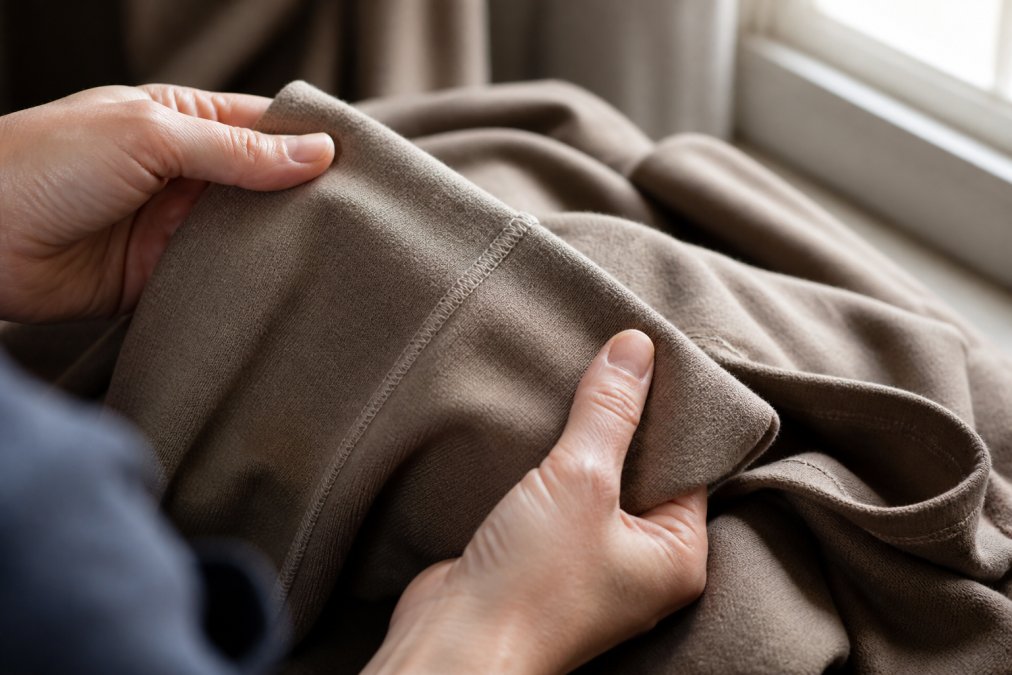
Examine the seams and hems. High-quality pieces use flat-felled seams (two parallel stitching lines) or French seams (enclosed edges) that don't unravel. Mass-market pieces often use single-line stitching that frays and fails. Tight, even stitching indicates quality control.
Check the weight and density of the fabric. Hold the garment up to light. Does light pass through easily (lightweight, often low-quality) or does the fabric feel substantial and opaque (better quality)? Heavier fabric typically lasts longer because it resists pilling and thinning.
Look for reinforced stress points. Armpits, crotches, and seams at movement points should have reinforced stitching or gussets. These details signal that the manufacturer anticipated how the garment would be worn and built durability into the design.
Test the dye stability. Rub a damp white cloth on the fabric. If color transfers immediately, the dye isn't set properly and the piece will fade quickly. Quality pieces have stable dyes that don't bleed.
These evaluations take 90 seconds per piece and reveal whether the price premium reflects actual quality or just brand positioning. Curated services theoretically handle this filtering for you, but you should still verify their selections meet these standards before committing to purchase.
How to Build a Capsule Wardrobe With Curated Pieces
A capsule wardrobe, a small collection of versatile, high-quality pieces that coordinate across multiple outfits, is where curated apparel actually delivers measurable value. The strategy reduces decision fatigue, minimizes waste, and ensures pieces work together.
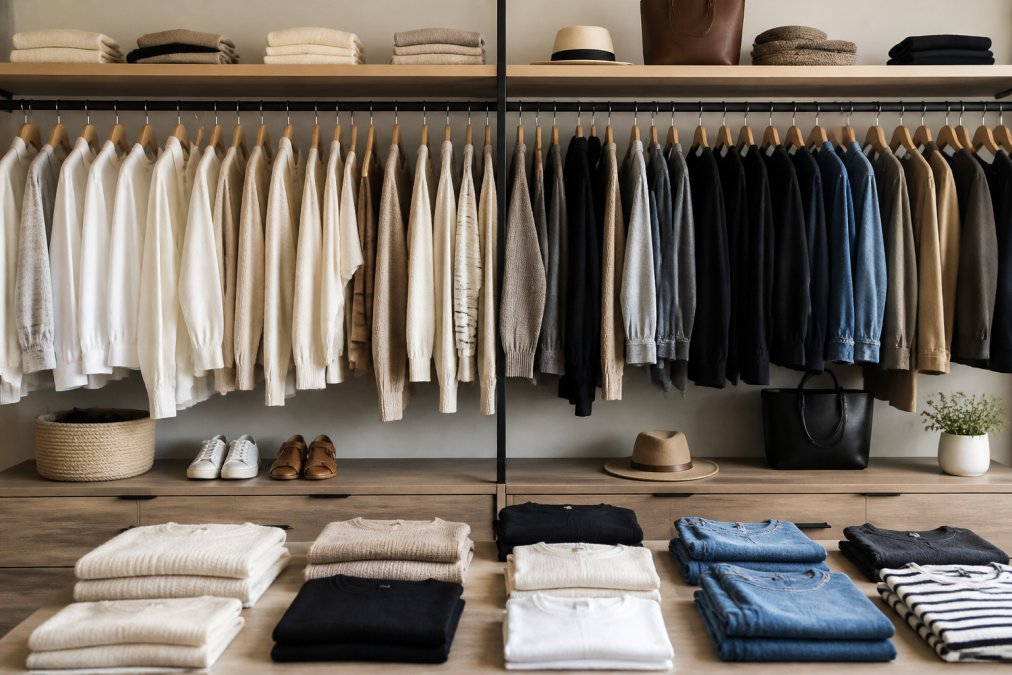
Start with a color palette. Choose 2-3 neutral base colors (black, white, gray, beige, navy) that will appear in every piece. This constraint maximizes outfit combinations because everything coordinates. A curated service that respects your stated color preferences saves enormous time by filtering thousands of options down to pieces that work together.
Build the foundation with investment staples: a white button-up shirt, neutral blazer, well-fitting jeans, plain tee in each base color, simple sweater, and neutral trousers. These pieces should cost more and last longer because you'll wear them 50+ times per year. A $60 white shirt made from high-quality cotton will outlast three $20 fast-fashion alternatives.
Add layering pieces that work across seasons: cardigans, lightweight sweaters, structured jackets. These multiply outfit combinations without requiring many new pieces. Curators excel at selecting layering pieces because the selection is genuinely difficult for most shoppers.
Include 3-5 accent pieces that reflect your personal style. These can be slightly bolder colors, interesting textures, or trend-forward items. Curators often shine here because they have early access to emerging trends and can select pieces that feel fresh without becoming dated quickly.
The capsule approach works with curated services because stylists can help you identify gaps in your existing wardrobe and recommend pieces that integrate rather than duplicate. However, the strategy only works if you're honest about your actual style and lifestyle. If you claim to want a minimalist wardrobe but actually prefer variety, curated apparel will frustrate you because you'll reject pieces that don't align with your stated preferences.
Resale Value and Circular Fashion: Does Curation Hold Up
One argument for curated apparel is that higher-quality pieces retain resale value better than mass-market alternatives. A $100 piece that resells for $40 after two years costs only $60 over that period, effectively reducing your long-term cost-per-wear.
Platforms like Depop, Poshmark, and Vestiaire Collective have created liquid secondary markets for used clothing. Luxury and designer pieces sell quickly. Mid-market branded pieces sell more slowly. Fast-fashion items rarely sell at any price.
But resale value depends on multiple factors beyond initial quality:
Brand recognition matters enormously. A $100 piece from a recognizable designer might resell for 40-50% of original price. The same quality piece from an unknown brand might resell for 10-20%. Curated apparel from established services includes recognizable brands, which helps resale value.
Condition and care affect resale dramatically. A piece worn 20 times and carefully maintained resells at a higher percentage than one worn 100 times. The resale calculation only works if you're genuinely taking care of garments.
Trend sensitivity matters. Classic pieces, white button-ups, neutral sweaters, well-fitting jeans, resell consistently. Trend-forward items become dated quickly. A curated service that focuses on timeless basics will have better resale economics than one emphasizing seasonal trends.
Size and fit affect marketability. Standard sizes resell faster than extended sizes. Pieces that fit conventionally sized bodies move faster than pieces with unusual proportions.
Realistic expectations: 20-30% resale value for mid-market curated pieces, 40-50% for designer-focused services.
The Verdict: When Curated Apparel Makes Financial Sense
After analyzing the economics, quality factors, and actual value delivery, is curated apparel worth the price depends on your specific situation.
Curated apparel makes financial sense if:
You struggle with decision-making and analysis paralysis prevents you from shopping effectively. You have disposable income and value convenience over optimization. You're building a capsule wardrobe and need help identifying pieces that coordinate. You prioritize quality and longevity over trend-chasing. You have a clear, consistent personal style that stylists can learn and apply. You're willing to provide detailed feedback to improve future selections.
Curated apparel doesn't make financial sense if:
You already know your style well and can shop efficiently on your own. You have a limited budget and every dollar needs to stretch. You enjoy the shopping process and view it as entertainment. You wear pieces infrequently or have unpredictable style preferences. You prefer fast fashion and trend-focused pieces over investment staples. You return most items, making styling fees a recurring sunk cost.
Curated apparel is a convenience premium. You're paying for time savings, expert filtering, and (theoretically) quality assurance. If those benefits align with your actual needs and budget, the price is justified. For most people, a hybrid approach works best: use curated services strategically, perhaps one or two shipments per year to refresh your wardrobe or fill specific gaps, rather than as an ongoing subscription. Alternatively, invest in quality basics from direct-to-consumer brands like Moore Graphics LLC that offer curated collections without per-shipment styling fees, then supplement with self-selected trend pieces from mass-market retailers.
The real value of curated apparel isn't in the pieces themselves, it's in the permission and framework it provides to think intentionally about your wardrobe. Whether that's worth the price depends entirely on whether you'd otherwise make better choices on your own.
Building a wardrobe that actually works for your life doesn't require expensive curation services, it requires intentionality and quality basics that coordinate. Moore Graphics LLC offers curated apparel and lifestyle goods designed to help you wear your story, with cozy sweatshirts, trendy tees, stylish hats, and gift-ready mugs that blend comfort with personality. Whether you choose a formal curated service or build your own capsule wardrobe with carefully selected pieces, the key is investing in quality items you'll actually wear repeatedly.
=== FAQ ANSWERS (audit these too, same rules) ===
[1] Q: What does 'curated apparel' actually mean in the fashion industry? A: Curated apparel refers to clothing and accessories selected by stylists or merchandisers based on specific criteria like quality, design, sustainability, or aesthetic cohesion. Unlike mass-market retail where inventory is driven by volume and trend cycles, curated collections are intentionally chosen to work together and meet defined standards. The curation process typically involves filtering for material composition, ethical manufacturing, and design consistency. This selectivity is what justifies the price premium over fast fashion alternatives.
[2] Q: How do I calculate cost-per-wear to evaluate if curated apparel is worth it? A: Cost-per-wear divides the item's price by the number of times you'll realistically wear it. A $100 sweater worn 100 times costs $1 per wear; the same sweater worn 10 times costs $10 per wear. Curated pieces typically justify higher upfront costs through durability and versatility. Track your actual wear patterns for items you already own to predict realistic usage for new purchases.
[3] Q: What should I look for when identifying high-quality fabrics in curated clothing? A: Check fabric content labels for natural fibers like cotton (combed or pima for durability), wool, linen, or silk, these age better than synthetics. Feel the weight and density; quality fabrics feel substantial, not flimsy. Examine seams for tight, even stitching with no loose threads. Look for finished hems and reinforced stress points like armholes and pockets. Pilling resistance, color retention, and shape retention are markers of quality construction. Curated brands typically provide material sourcing details and care instructions that reflect investment in longevity.
[4] Q: Is curated apparel worth buying if I'm not into expressing my personal style? A: Yes. Curation isn't only about self-expression, it's about quality, fit, and versatility. Many curated collections focus on timeless basics and investment staples designed for everyday comfort and durability. If you prioritize clothing that lasts, fits well, and requires minimal maintenance, curated apparel offers genuine value regardless of your interest in fashion trends. The key is finding curated brands that align with your lifestyle, some specialize in professional workwear, others in casual everyday pieces, and some in sustainable basics.
[5] Q: Do curated pieces hold resale value better than mass-market clothing? A: Generally yes. Curated apparel typically retains a higher percentage of its original value on the resale market, compared to fast fashion. This is because curated pieces are often made from durable materials, feature timeless designs, and come from brands with established reputation. Second-hand markets value quality construction and material composition heavily. If you buy strategically within curated collections, focusing on neutral colors, classic silhouettes, and durable fabrics, you can recover a meaningful portion of your investment through resale, effectively lowering your true cost-per-wear.
Frequently Asked Questions
What does 'curated apparel' actually mean in the fashion industry?
Curated apparel refers to clothing and accessories selected by stylists or merchandisers based on specific criteria like quality, design, sustainability, or aesthetic cohesion. Unlike mass-market retail where inventory is driven by volume and trend cycles, curated collections are intentionally chosen to work together and meet defined standards. The curation process typically involves filtering for material composition, ethical manufacturing, and design consistency. This selectivity is what justifies the price premium over fast fashion alternatives.
How do I calculate cost-per-wear to evaluate if curated apparel is worth it?
Cost-per-wear divides the item's price by the number of times you'll realistically wear it. A $100 sweater worn 100 times costs $1 per wear; the same sweater worn 10 times costs $10 per wear. Curated pieces typically justify higher upfront costs through durability and versatility. Track your actual wear patterns for items you already own to predict realistic usage for new purchases.
What should I look for when identifying high-quality fabrics in curated clothing?
Check fabric content labels for natural fibers like cotton (combed or pima for durability), wool, linen, or silk, these age better than synthetics. Feel the weight and density; quality fabrics feel substantial, not flimsy. Examine seams for tight, even stitching with no loose threads. Look for finished hems and reinforced stress points like armholes and pockets. Pilling resistance, color retention, and shape retention are markers of quality construction. Curated brands typically provide material sourcing details and care instructions that reflect investment in longevity.
Is curated apparel worth buying if I'm not into expressing my personal style?
Yes. Curation isn't only about self-expression, it's about quality, fit, and versatility. Many curated collections focus on timeless basics and investment staples designed for everyday comfort and durability. If you prioritize clothing that lasts, fits well, and requires minimal maintenance, curated apparel offers genuine value regardless of your interest in fashion trends. The key is finding curated brands that align with your lifestyle, some specialize in professional workwear, others in casual everyday pieces, and some in sustainable basics.
Do curated pieces hold resale value better than mass-market clothing?
Generally yes. Curated apparel typically retains a higher percentage of its original value on the resale market, compared to fast fashion. This is because curated pieces are often made from durable materials, feature timeless designs, and come from brands with established reputation. Second-hand markets value quality construction and material composition heavily. If you buy strategically within curated collections, focusing on neutral colors, classic silhouettes, and durable fabrics, you can recover a meaningful portion of your investment through resale, effectively lowering your true cost-per-wear.