 how-to
How to Find High Quality Sweatshirts That Last
Table of Contents
- What Makes High Quality Sweatshirts Worth the Price
- Best Fabric for Sweatshirts: Cotton, Fleece, and Blends Compared
- How to Check Sweatshirt Quality Before You Buy
- Fit, Silhouette, and Why Consistency Matters
- Cost-Per-Wear: How to Evaluate the Real Value of High Quality Sweatshirts
- Sweatshirt Care Instructions That Protect Your Investment
- Environmental Impact and Sustainable Sourcing
- Frequently Asked Questions
Last Updated: August 25, 2026
What Makes High Quality Sweatshirts Worth the Price
High quality sweatshirts are defined by a combination of fabric density, construction precision, and material integrity that holds up through repeated washing, heavy wear, and years of use. The difference between a great piece and a disappointing one almost always comes down to a handful of specific, measurable factors.
Most people assume price equals quality. It doesn't. You can spend a lot on a name and get a thin, poorly constructed garment that pills after ten washes. The real signals are technical, and once you know what to look for, you'll never buy a sweatshirt blind again.
Fabric Density and GSM: The Numbers That Matter
GSM (grams per square meter) is the standard measurement for fabric weight in garments. For sweatshirts, GSM is one of the most reliable indicators of durability and warmth.
As a general guide:
- 180-250 GSM: Lightweight, suitable for layering in mild weather
- 270-350 GSM: Mid-weight, the everyday wear sweet spot
- 350-500+ GSM: Heavyweight, built for cold climates and long-term durability
A genuine heavyweight sweatshirt typically falls between 380 and 450 GSM. Anything labeled "premium" but weighing in under 270 GSM should raise questions. The Textile Exchange fiber market report consistently identifies fabric weight as a primary quality marker in performance and lifestyle apparel.
Higher GSM doesn't just mean warmer. It means better pilling resistance, improved seam strength, and a more substantial soft-hand feel that holds its shape after washing.
Garment Construction and Seam Strength
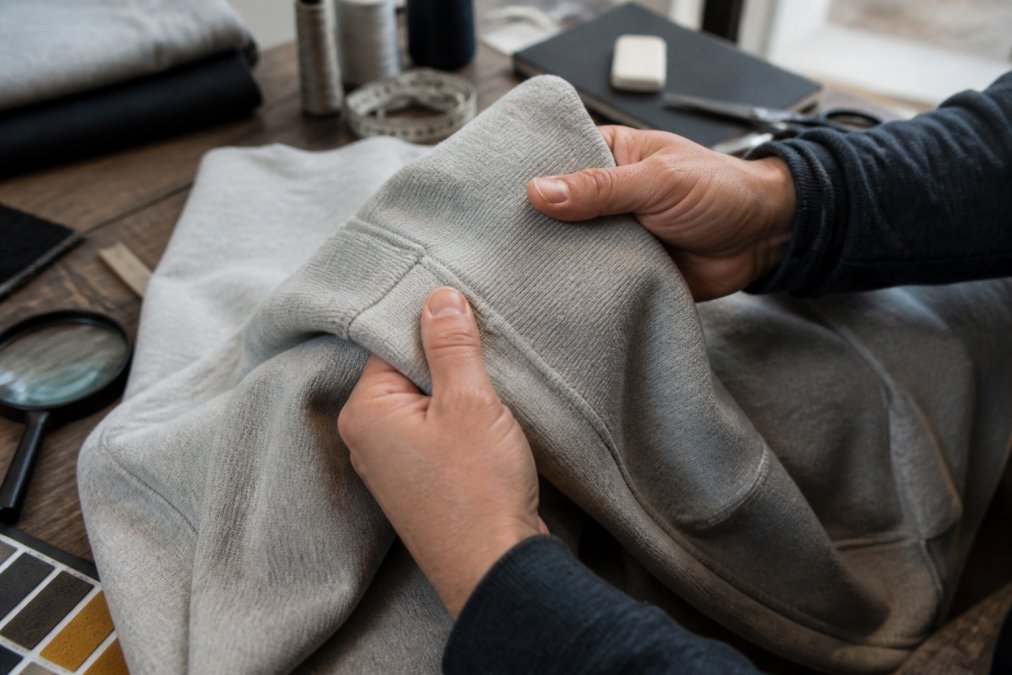
The biggest mistake shoppers make is ignoring the seams. Pull the shoulder seam of any sweatshirt gently apart and look at the stitching. Quality garments use reinforced stitching with tight, even stitch density. Loose threads, skipped stitches, or visible gaps are red flags.
Look for these construction details:
- Double-needle stitching at hems and cuffs for durability
- Flatlock seams that lie flat against the body and resist abrasion
- Ribbed cuffs and waistbands with consistent tension across the full circumference
- Drawstring hardware that is securely anchored, not just knotted through a hem
Garment construction determines longevity more than any other single factor. A well-sewn sweatshirt in mid-weight fabric will outlast a poorly sewn heavyweight one.
Best Fabric for Sweatshirts: Cotton, Fleece, and Blends Compared
Fabric choice shapes every aspect of how a sweatshirt feels, performs, and ages. The best fabric for sweatshirts depends on your climate, how you plan to wear it, and how much you care about breathability versus insulation.
| Fabric Type | GSM Range | Breathability | Durability | Best For |
|---|---|---|---|---|
| Ring-spun cotton | 200-320 GSM | High | High | Everyday wear, warm climates |
| French terry | 250-350 GSM | Medium-high | High | Active use, transitional seasons |
| Loopback fleece | 300-450 GSM | Medium | Very high | Cold weather, heavy daily use |
| Cotton-poly blend | 240-380 GSM | Medium | High | Year-round versatility |
| Synthetic fleece | 180-300 GSM | Low-medium | Medium | Budget layering |
Ring-Spun Cotton vs. Standard Cotton
Ring-spun cotton is produced by continuously twisting and thinning cotton fibers during spinning, which creates a stronger, softer yarn than standard open-end spun cotton. The practical difference is significant: ring-spun fabric has better textile integrity, resists pilling more effectively, and develops a softer hand feel over time rather than degrading.
Standard cotton sweatshirts often feel acceptable in the store but become rough and misshapen after repeated washing. Ring-spun cotton holds its structure. If a garment label says "100% cotton" without specifying ring-spun, you're likely getting the cheaper open-end version.
Pre-shrunk ring-spun cotton is the gold standard for fit consistency. Garments that haven't been pre-shrunk can lose significant size in the first wash, which is a common complaint with lower-quality pieces.
French Terry and Loopback Fleece Explained
French terry is a knit fabric with a smooth face and looped pile on the reverse. It offers breathability closer to a standard jersey while providing more warmth than a thin cotton knit. Many higher-end athletic and lifestyle sweatshirts use French terry because it manages moisture reasonably well without the bulk of full fleece.
Loopback fleece (sometimes called loopback terry) takes that loop structure further. The interior loops are left uncut, creating a soft, insulating lining that traps warmth effectively. This is the construction behind most classic heavyweight sweatshirts. It's the reason a quality loopback fleece garment feels distinctly different from a cheap brushed fleece alternative: the loops hold their structure, while brushed fleece tends to mat and pill quickly.
For cold-weather everyday wear, loopback fleece in a heavyweight GSM is the most durable long-term choice.
How to Check Sweatshirt Quality Before You Buy
Checking sweatshirt quality before purchase requires examining four things: the label, the fabric feel, the seam construction, and the garment's response to a simple stretch test. You don't need special equipment.
Decoding the Garment Label
The care label is one of the most underused tools in apparel shopping. According to the Federal Trade Commission care labeling rule for textile products, manufacturers are required to provide accurate care instructions on all garments sold in the United States. That label tells you more than just washing instructions.
Look for:
- Fiber content percentage: Higher cotton content generally means better breathability and natural fibers
- Country of manufacture: Not a quality guarantee, but useful context
- Specific fabric names: "Ring-spun," "combed cotton," "French terry," and "loopback" are signals of intentional material selection
- Pre-shrunk notation: Critical for fit consistency over time
What's missing from the label matters too. Vague descriptions like "soft cotton blend" without percentages or specific fiber names often indicate lower-grade materials.
Simple Fabric Tests You Can Do at Home
These tests work in-store or when evaluating a garment you've received:
The stretch and recovery test: Stretch a section of fabric horizontally, hold for three seconds, release. Quality fabric with good elasticity and colorfastness returns to its original shape almost immediately. Fabric that stays deformed has poor recovery and will lose its silhouette quickly.
The pill resistance check: Rub two sections of the fabric together briskly for about ten seconds. Lower-quality fabrics will begin to show surface fuzz or early pilling immediately. Ring-spun cotton and tightly woven fabrics resist this noticeably better.
The light test: Hold the fabric up to a light source. Thin, loosely woven fabric becomes nearly transparent. A quality heavyweight sweatshirt should remain opaque and show consistent fabric density throughout.
The seam pull test: Gently pull the seam from both sides. Quality reinforced stitching won't show gaps or stress lines under moderate tension.
Fit, Silhouette, and Why Consistency Matters
A sweatshirt's silhouette is a design choice, but fit consistency across washes is a quality issue. These are two different things, and conflating them leads to a lot of buyer disappointment.
Silhouette types for sweatshirts generally fall into a few categories: relaxed/oversized, classic regular fit, and fitted or slim cut. None of these is inherently better. The question is whether the garment maintains that silhouette after washing. A relaxed-fit sweatshirt that becomes shapeless after three washes wasn't relaxed by design; it was just poorly constructed.
Fit consistency depends on:
- Pre-shrunk fabric treatment
- Seam placement and reinforcement at stress points (underarm, shoulder, cuff)
- Ribbed cuffs and waistbands that maintain tension without overstretching
A common mistake is buying a sweatshirt that fits perfectly in the store and washing it in hot water. Most quality garments specify cold-wash care precisely because pre-shrunk fabric can still experience minor shrinkage under heat stress. Follow the label.
The other thing most guides miss: shrinkage resistance is not the same as shape retention. A sweatshirt can hold its size while losing its structure entirely, especially through the shoulder and chest. Look for reinforced shoulder seams as a specific indicator of long-term shape retention.
Cost-Per-Wear: How to Evaluate the Real Value of High Quality Sweatshirts
The cost-per-wear framework is the most honest way to evaluate whether a sweatshirt is worth its price. The calculation is simple:
Cost-per-wear = Purchase price ÷ Number of times worn
A sweatshirt that costs more but lasts three times longer and gets worn twice as often delivers dramatically better value than a cheap alternative that fades, shrinks, or pills within a season.
Here's how to apply it practically:
- Estimate how many times per month you'll realistically wear the garment
- Estimate how many months or years it will last based on construction quality
- Divide the purchase price by the total estimated wears
Many people find that a well-constructed, heavyweight sweatshirt worn twice a week over three years costs a fraction of a cent per wear, while a cheaper version worn half as often for one season costs significantly more per use.
The Moore Graphics LLC collection is built around this principle. Cozy sweatshirts designed for everyday life aren't a luxury purchase when you calculate what you actually get per wear over time.
Sweatshirt Care Instructions That Protect Your Investment
Proper care extends the life of any sweatshirt significantly. The irony is that most premature garment failure isn't a manufacturing defect; it's the result of washing and drying habits that degrade fabric faster than normal wear ever would.
The core rules for extending sweatshirt life:
- Wash cold, always. Hot water accelerates shrinkage and degrades elastic fibers in ribbed cuffs and waistbands
- Turn inside out before washing. This protects the outer surface from abrasion and preserves colorfastness
- Avoid high-heat drying. Tumble dry on low or air dry flat to maintain fabric density and shape
- Skip fabric softener on fleece. Fabric softener coats fleece fibers and reduces their natural soft-hand feel over time
- Wash with similar weights. Heavy sweatshirts abrading against lightweight items accelerates surface pilling on both garments
For heavyweight loopback fleece specifically, air drying is worth the extra time. The loop structure that makes these garments so warm is also susceptible to heat-induced matting in a dryer. A flat-dried heavyweight sweatshirt maintains its loft and insulating properties far longer.
Environmental Impact and Sustainable Sourcing
The environmental cost of apparel manufacturing is real, and it's worth understanding before making a purchase. As documented in the EPA's overview of textile waste and sustainability, textiles represent a significant portion of municipal solid waste, with fast fashion contributing disproportionately to that total.
The connection to quality is direct: a sweatshirt that lasts five years instead of one year reduces the environmental cost per wear by roughly 80%. Durability is sustainability. This is the most underappreciated angle in the "buy better, buy less" conversation.
Beyond durability, sustainable sourcing in the sweatshirt category involves a few specific considerations:
- Natural fiber content: Cotton and wool have different environmental profiles than synthetic polyester, though organic certification matters significantly for cotton's water and pesticide footprint
- Manufacturing transparency: Brands that publish factory information or third-party audit results are generally more accountable than those that don't
- Dyeing and finishing processes: Colorfastness treatments that don't involve harmful chemicals are a growing area of focus in responsible garment production
The Better Cotton Initiative's standards for responsible cotton sourcing provides a useful framework for understanding what responsible natural fiber sourcing actually looks like in practice.
For conscious consumers, the most practical question to ask is whether a brand can tell you where and how its garments are made. Vague claims about being "ethically made" without specifics are marketing language. Specific factory partnerships, third-party certifications, and published sourcing standards are the real indicators.
Moore Graphics LLC's approach to curation focuses on pieces designed to last and to carry meaning. Gifting a well-made sweatshirt isn't just a thoughtful gesture; it's a choice that holds up over time in every sense.
Frequently Asked Questions
Q: What fabric blend is best for a high-quality sweatshirt?
A: A blend of ring-spun cotton and polyester, typically around 80/20 or 60/40, balances soft-hand feel with shrinkage resistance and durability. Pure cotton offers breathability and a natural feel, while French terry and loopback fleece constructions add structure and warmth. For everyday wear, look for a heavyweight fabric in the 300-400 GSM range, which signals better garment density and longer-lasting textile integrity.
Q: How can you tell if a sweatshirt is good quality?
A: Check the garment label for GSM weight, fiber content, and pre-shrunk treatment. Run your fingers along the seams to feel for reinforced stitching and flat, even construction. Stretch a small section of fabric and release it, quality fabric snaps back without distorting. Look for ribbed cuffs that hold their shape, colorfastness in the dye, and drawstring hardware that sits flush. These details signal durable garment construction rather than a budget build.
Q: Are 100% cotton sweatshirts better than blends?
A: Not necessarily. Pure cotton sweatshirts offer excellent breathability and a natural feel, but they shrink more easily and can lose shape over time. A cotton-polyester blend adds pilling resistance, fit consistency, and moisture-wicking properties that pure cotton lacks. For high quality sweatshirts meant for everyday wear and repeated washing, a well-constructed blend often outperforms 100% cotton in long-term durability and colorfastness.
Q: What should I look for when buying a blank hoodie or sweatshirt?
A: Prioritize fabric weight (aim for 300 GSM or above for a heavyweight feel), seam construction, and fiber content. Check that the ribbed cuffs and waistband have strong elastic recovery, and inspect the stitching density along the shoulders and underarms where stress is highest. For printed or custom garments, a pre-shrunk fabric base ensures the print stays aligned after washing. Fit consistency across sizes is another sign of a brand that invests in quality garment construction.
Finding genuinely high quality sweatshirts takes more than browsing a product page. The technical details, fabric specifications, and construction standards covered here give you a real framework for evaluating any garment before you commit. Moore Graphics LLC curates cozy sweatshirts and everyday apparel built around these principles, so you can wear something that actually lasts. Explore the collection and find a piece worth keeping.